
Most Secure iMessage API Provider: 6 Top Tools in 2026
Most Secure iMessage API Provider: 6 Top Tools in 2026
When you look for the most secure iMessage API provider, blue bubbles are only part of the decision. You also need to know who can read your customer conversations, where that data sits, and what happens to your phone number if Apple restricts an account.
Providers don't protect your data the same way. Some give each business a dedicated phone number, while others put clients on shared lines or publish very little about their security.
In this guide, we’ll look at the top six iMessage API providers and how well each one protects your data. You’ll also learn which risks to watch for and what to check before you pick a provider.
TL;DR
These are the most secure iMessage API providers in 2026:
- Sendara: Best for CRM-driven sales teams that need a dedicated number on real Apple hardware.
- Linq: Best for companies that must pass enterprise security reviews.
- Sendblue: Best for regulated industries that need HIPAA support.
- Blooio: Best for budget-conscious teams with simple security needs.
- Project Blue: Best for small teams that want a simple setup.
- Photon: Best for developers who build iMessage into AI agents and apps.
What Makes an iMessage API Secure?
A secure iMessage API protects customer conversations and keeps unauthorized parties away from your data.
Apple’s encryption covers only part of this, because the rest depends on how the provider manages its Apple accounts, where it stores message content, and how it connects with the CRM your team already uses.
How Does an iMessage API Work?
An iMessage API is an application programming interface that lets your team send and receive iMessages from a CRM or an automated workflow, so nobody has to type each text by hand in the Messages app.
When your software sends a request, the provider checks your API credentials, passes the request through its own Apple devices, and delivers the text to your prospect’s phone number.
Replies return to your CRM via webhooks, so the provider handles sensitive customer information at every step of the conversation.
Is an iMessage API as Secure as iMessage Itself?
Apple’s iMessage uses end-to-end encryption, so only the sender’s and the recipient’s devices can normally read a message.
An API from an outside vendor adds new places where the text gets opened and stored, and the encryption on the delivery itself does not cover the full path to your CRM.
For real data privacy, look for a provider that encrypts data in transit and at rest and limits which staff can read your messages.
The provider should also explain in writing how long it keeps your data, how you can delete it, and which audits back up its security claims.
Blue-Bubble APIs vs Apple Messages for Business
Apple Messages for Business is Apple’s official channel for brands, and it runs through Apple-approved providers. Customers see a verified business name and logo inside a grey bubble, which works well for support but feels less personal than a regular text.
A blue-bubble API sends texts from a normal phone number, so they look like they came from a person, which is why iMessage gets higher response rates than SMS with new prospects.
Apple does not approve these APIs, so the security of your account depends on how well the provider protects its Apple IDs and systems.
Security Risks That Come With iMessage APIs
Even a secure iMessage API can introduce risks when customer conversations pass through third-party systems.
Once you know these risks, you can choose a provider that protects your data and keeps your conversations running.
Apple ID Bans and Lost Numbers
Some third-party iMessage APIs rely on Apple accounts to send messages. If Apple flags an account for unusual activity or suspected spam, it may restrict access and cut off your texts.
This can leave sales teams unable to reach customers or continue existing conversations. Ask each vendor how it manages Apple accounts and how fast it can restore access after a restriction.
Also confirm whether you can keep your phone number if you leave the service.
Data Breaches at the Vendor
When an iMessage API connects to your CRM, the provider may process phone numbers and message content that belong to your customers.
If its systems are compromised, that data could be exposed. Weak API authentication and loose access controls raise the risk, especially when the provider also keeps messages it has no reason to store.
Choose a provider that encrypts stored data and limits which employees can read it. It should also explain how and when it deletes old messages.
Shared Lines and Spam From Other Clients
Some iMessage API providers may use shared accounts or infrastructure for multiple customers.
If another business sends spam or breaks Apple’s rules, restrictions on shared infrastructure could affect your service, even when your own practices follow the rules.
Carriers and phones now judge senders by how people react to their texts, which is one of the six shifts changing SMS outreach.
Dedicated accounts or isolated infrastructure can reduce this risk, but they don’t remove the possibility of restrictions.
Ask whether your line is dedicated to your business and how the provider watches for abuse from other clients. You should also know what happens to your service if another customer’s behavior causes a restriction.
6 Best Secure iMessage API Providers in 2026
Not every iMessage API provider approaches security the same way. Some focus on enterprise compliance, and others put more weight on CRM workflows or developer control.
Below are the top six providers, how each one protects customer data, and the type of team it fits best.
1. Sendara: Best for CRM-Driven Sales Teams
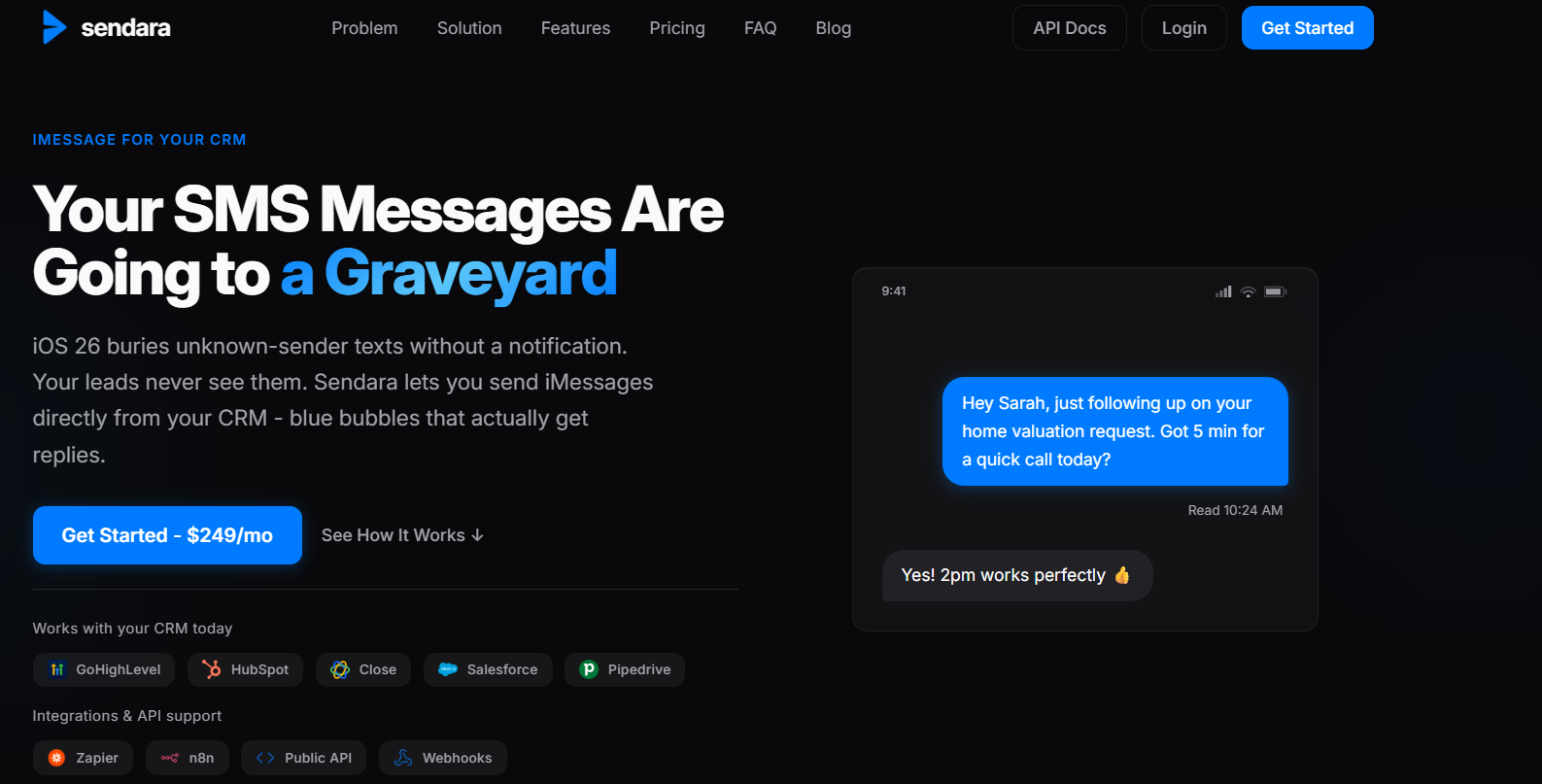
Sendara is an iMessage platform that lets sales teams send and receive iMessages directly from their CRM. It works natively with GoHighLevel, HubSpot, Salesforce, Close, and Pipedrive, and it comes with API and webhook access for custom workflows.
On the security side, Sendara runs each line on real Apple hardware with legitimate Apple IDs and avoids jailbreaks and protocol hacks.
Every business also gets a dedicated number instead of a shared one, so it keeps its own identity with customers and reduces the risk of being affected by unrelated senders.
Each line can start 50 new conversations a day, and Sendara only permits texts to opted-in prospects and existing customers, never unsolicited mass outreach.
If a recipient cannot receive an iMessage, the text falls back to Rich Communication Services (RCS) or SMS, and the conversation continues.
Best for: Sales teams that want a dedicated iMessage number inside their CRM and would rather not run their own infrastructure.
2. Linq: Best for Enterprise Security Reviews
Image source: linqapp.com
Linq builds an iMessage API for businesses and developers that puts communication tools into their own web applications and AI agents. Its REST API covers iMessage with RCS and SMS fallback for Android users, and a separate voice API adds voice calls on the same platform.
Linq holds a SOC 2 Type II certification and states that customer message content is encrypted and inaccessible to its own team. Its documentation lists Transport Layer Security (TLS) 1.2 or higher for data in transit and AES-256 encryption for data at rest.
Each API request also requires key-based authentication, which teams manage from the Linq dashboard.
For data privacy, the platform has an optional 24-hour retention window that teams can turn on through their Linq support contact. Each customer gets dedicated lines, and the company advertises a 99.95% uptime service-level agreement (SLA).
Its robust documentation covers group chats and read receipts, and developers can use official software development kits (SDKs) in several languages. Most of the product focuses on developers and AI agents, though Linq also has a GoHighLevel integration.
Best for: Enterprises that need documented security controls and data retention options to meet regulatory compliance checks in a formal vendor review.
3. Sendblue: Best for Regulated Industries
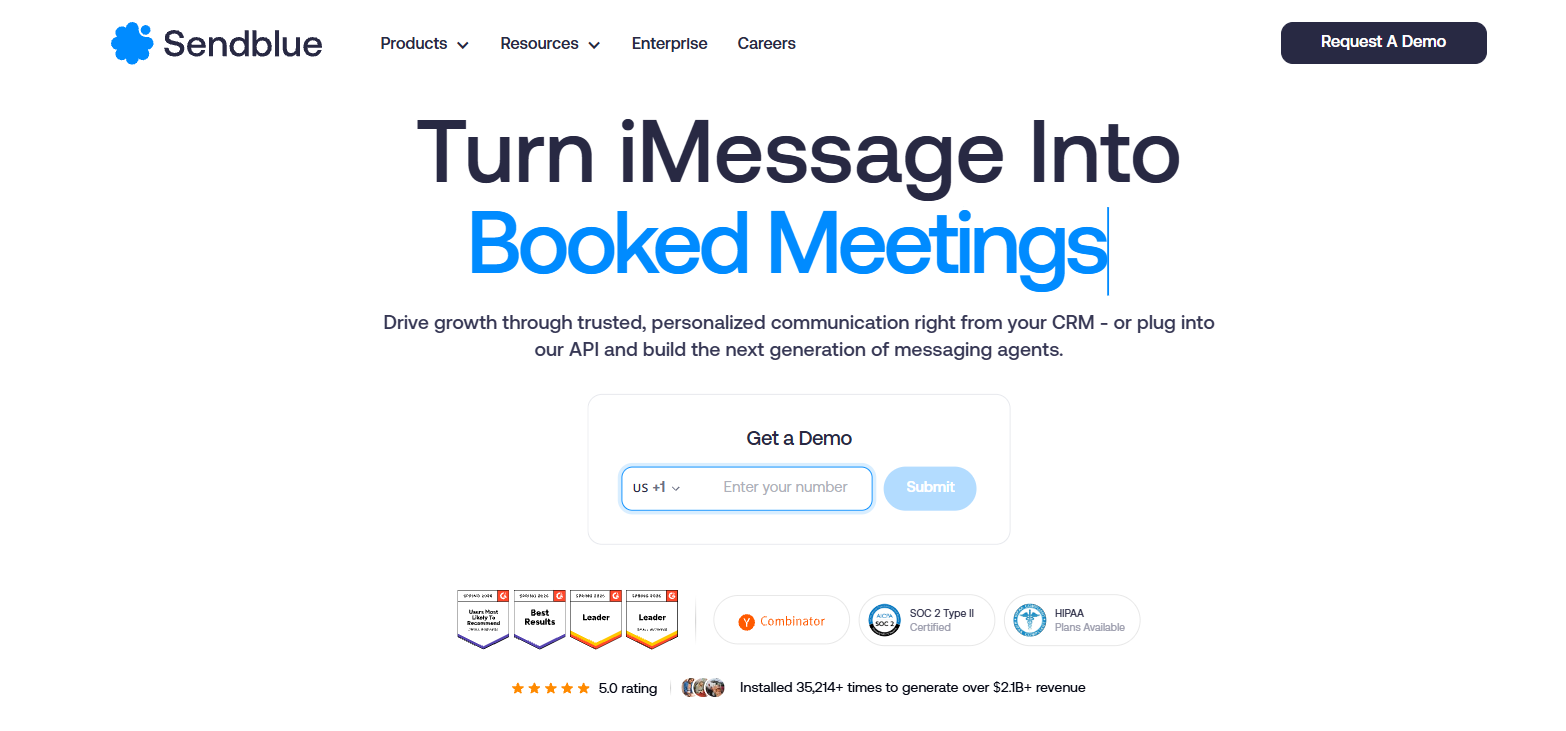
Image source: sendblue.com
Sendblue is an iMessage API provider for businesses that want to send and receive blue-bubble messages through their existing software. Its REST API works with webhooks and native CRM integrations, and messages fall back to RCS or SMS when a contact uses an Android phone.
Sendblue reports SOC 2 Type II certification and has HIPAA plans that run on a dedicated environment with business associate agreements (BAAs). Its security documentation lists TLS encryption for all API communications and encryption at rest, and webhooks must use HTTPS.
A BAA covers only the vendor’s own systems, though. Apple controls the iMessage delivery path itself, so HIPAA support from any provider does not make your texts compliant on its own.
Each API request needs both an API key and a secret key, and Sendblue blocks frontend calls so credentials stay on your server. Rate limits apply at the account and sender levels and vary by plan.
Best for: Regulated businesses, such as healthcare providers and financial advisors, that need documented security controls and a signed BAA before they text clients.
4. Blooio: Best for Budget-Conscious Teams
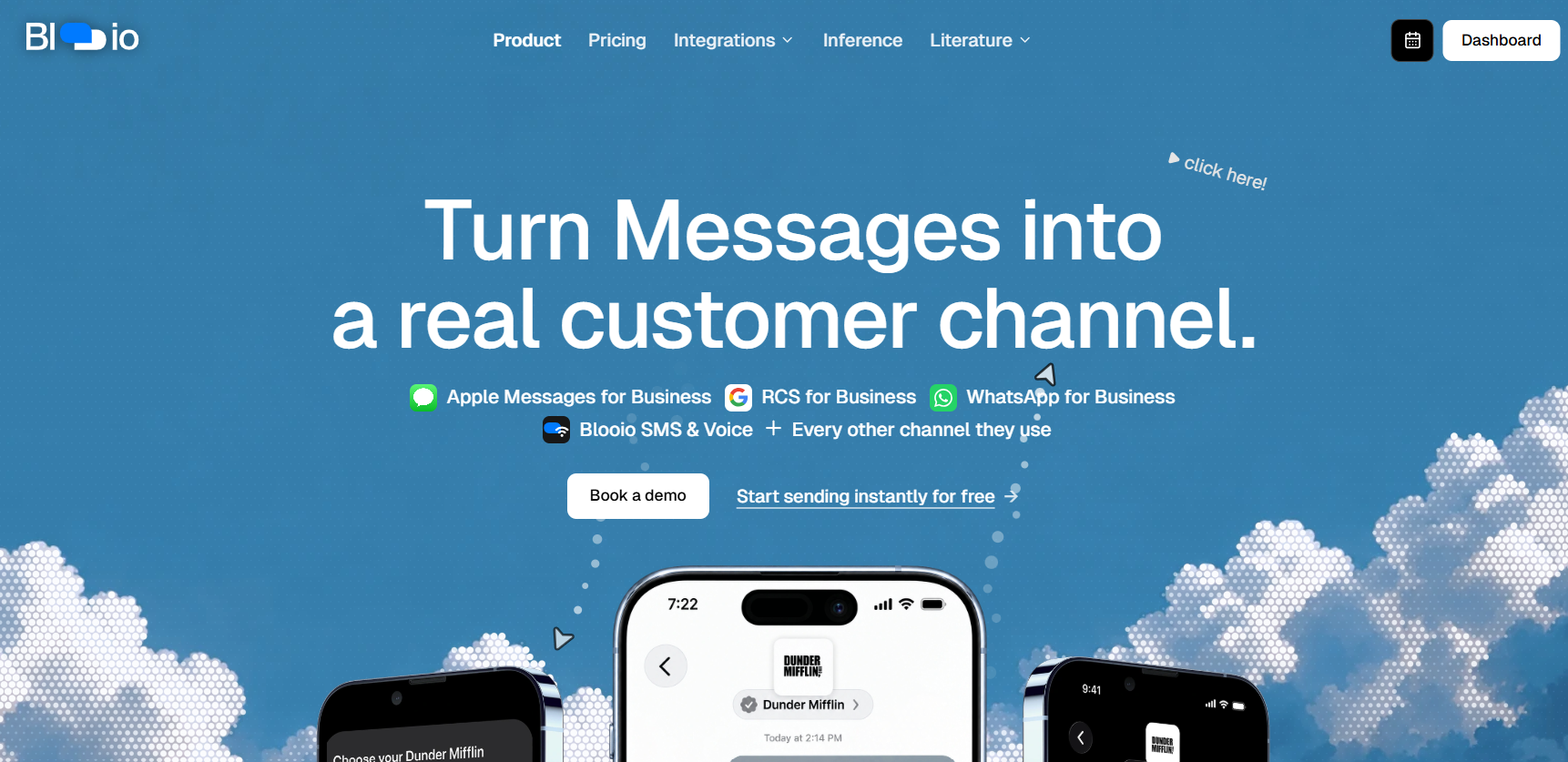
Image source: blooio.com
Blooio lets businesses and developers send iMessages through a REST API without the need to manage their own Apple hardware.
It supports iMessage with RCS and SMS fallback, and its webhooks report incoming replies and delivery updates. Developers can also test its full capabilities in a free sandbox before they deploy any code.
On the security side, the API uses API keys and OAuth 2.0 authentication, and teams can create or revoke keys from the Blooio dashboard.
Webhooks are signed and can be rotated, which gives developers more control over their integrations and makes it harder for anyone to send fake requests to your systems.
Blooio offers both shared and dedicated numbers, so teams that want to avoid the risks of a shared line can choose their own.
Best for: Small businesses and developers who want a low-cost iMessage API with clear authentication controls and the option to move to a dedicated line later.
5. Project Blue: Best for Simple Setups
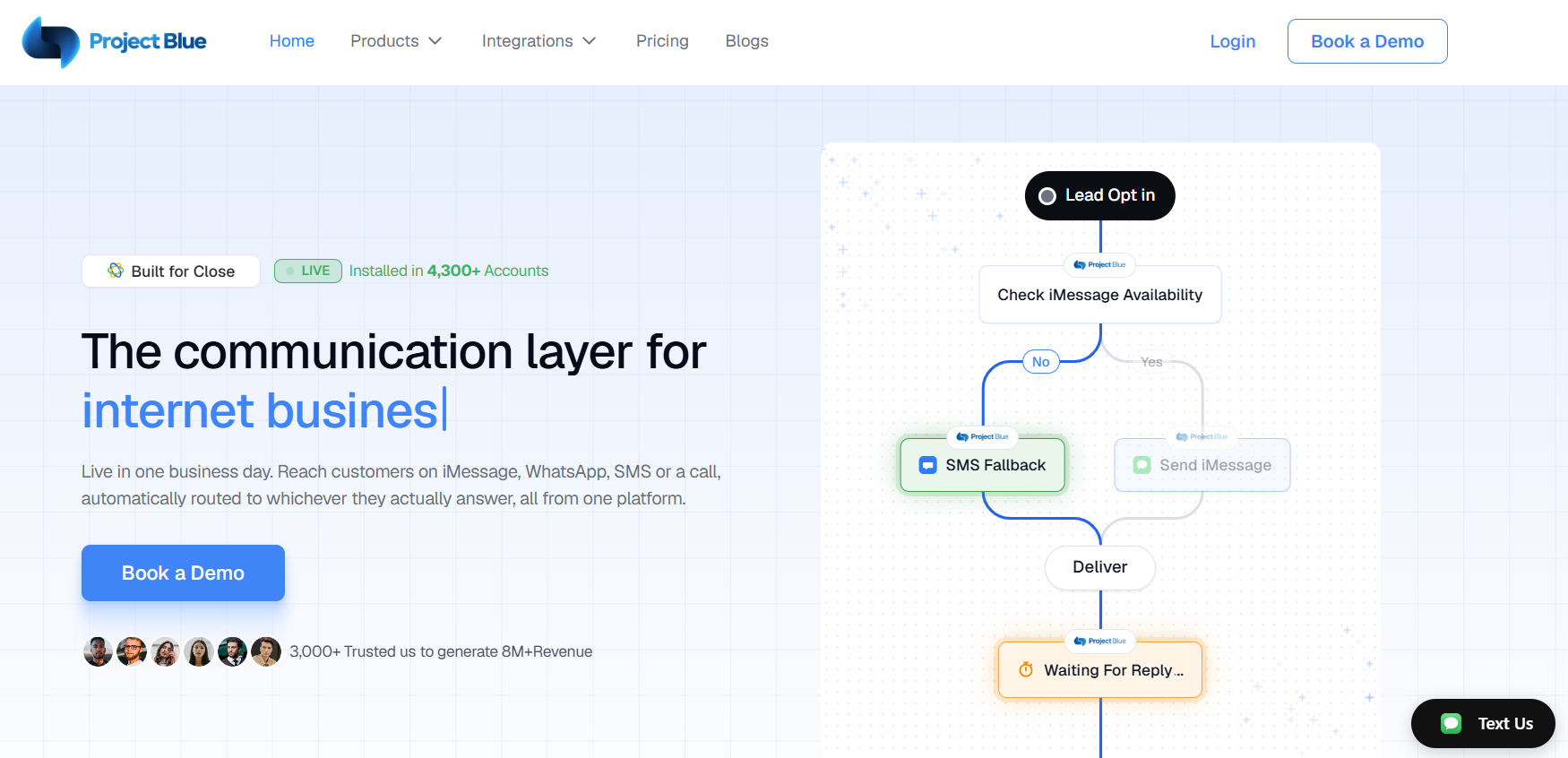
Image source: tryprojectblue.com
Project Blue is a texting and calling solution that gives each business a dedicated line, mainly for iMessages. It works with CRMs such as GoHighLevel and HubSpot, and its REST API adds custom integration functionality.
When a contact cannot receive an iMessage, the platform falls back to WhatsApp and then SMS on its own.
From a security view, each line belongs to one customer and is not shared, so other clients’ habits are far less likely to affect your number.
Bulk blasts are not allowed on iMessage lines, and campaigns go through a separate marketing number instead, which keeps your main line clean.
Line health monitoring tracks delivery and reply rates and sends alerts when they change, which can warn you early when a line runs into trouble.
You can also port an existing phone number, so you keep control of the number your customers already know.
Best for: Small sales teams that need a managed iMessage setup inside their CRM and want little technical work on their side.
6. Photon: Best for Developers and AI Agents
Image source: photon.codes
Photon offers an iMessage API for developers who create AI agents, chatbots, and other chat applications. Its open-source SDK connects one backend to iMessage along with WhatsApp and Telegram, so a single codebase can serve each channel.
For security, Photon reports SOC 2 Type II compliance and HIPAA support for its hosted platform.
Webhooks are signed with HMAC, so your server can confirm that each event really came from Photon, and because the SDK code is open source, your team can review how it handles messages before you deploy.
Photon offers a free shared line pool and dedicated lines that belong to one project. A shared line can only text a number after that person has messaged the line first, which limits spam from the pool.
Dedicated lines give teams more control, since no other project sends from the same number.
Best for: Developers and AI companies that need an open-source iMessage API with signed webhooks and support for automated conversations across several channels.
The Security Checklist Before You Sign
Before you pick an iMessage API provider, check how it protects customer data and keeps your service running.
Most providers do not show all of this on their website or pricing page, so these key factors will help you spot risks and see which vendor fits your business needs.
Infrastructure and Apple IDs
Ask whether your business gets a dedicated number and Apple account or shares infrastructure with other customers. Shared resources can expose your service to restrictions that another sender causes.
Find out whether the service runs on real Apple hardware, who manages the accounts, and what happens if Apple restricts one. Also confirm that you can port your number to another service if you leave.
Data Storage, Encryption and Retention
A secure iMessage API should never keep conversations on its cloud servers in plain text. Ask whether the vendor can read message content and how long it stores conversations.
Check that you can delete customer data on request and that backups follow the same retention rules. Apple’s end-to-end encryption no longer protects a message once it enters your CRM, so the vendor’s own controls decide how safe that data stays.
Audit Reports and Compliance
Look for independent security audits such as SOC 2 Type II instead of claims about secure infrastructure alone. If you handle personal data, ask about GDPR requirements and a data processing agreement.
Healthcare businesses should also check whether the provider supports HIPAA and will sign a BAA. A certification or signed agreement still does not make every workflow compliant on its own.
API Keys, Access Controls, and Webhooks
Secure communication APIs require authentication for every request and enable you to revoke or rotate credentials when needed. Role-based permissions should limit who can open customer conversations and delivery receipts, whether from the dashboard or a mobile app.
Webhooks should use HTTPS and support signature verification, so your CRM can confirm that each incoming event really came from the provider.
Sending Rules and SMS Fallback Compliance
Check whether the provider requires customer consent and limits new conversations, since these rules block unsolicited mass texts and reduce the risk of account restrictions.
If the API falls back to SMS or RCS, confirm how consent and opt-out requests carry over between channels. SMS also lacks the end-to-end encryption of iMessage, so keep sensitive information out of fallback messages unless other protections are in place.
Send iMessages Within Your CRM With Sendara
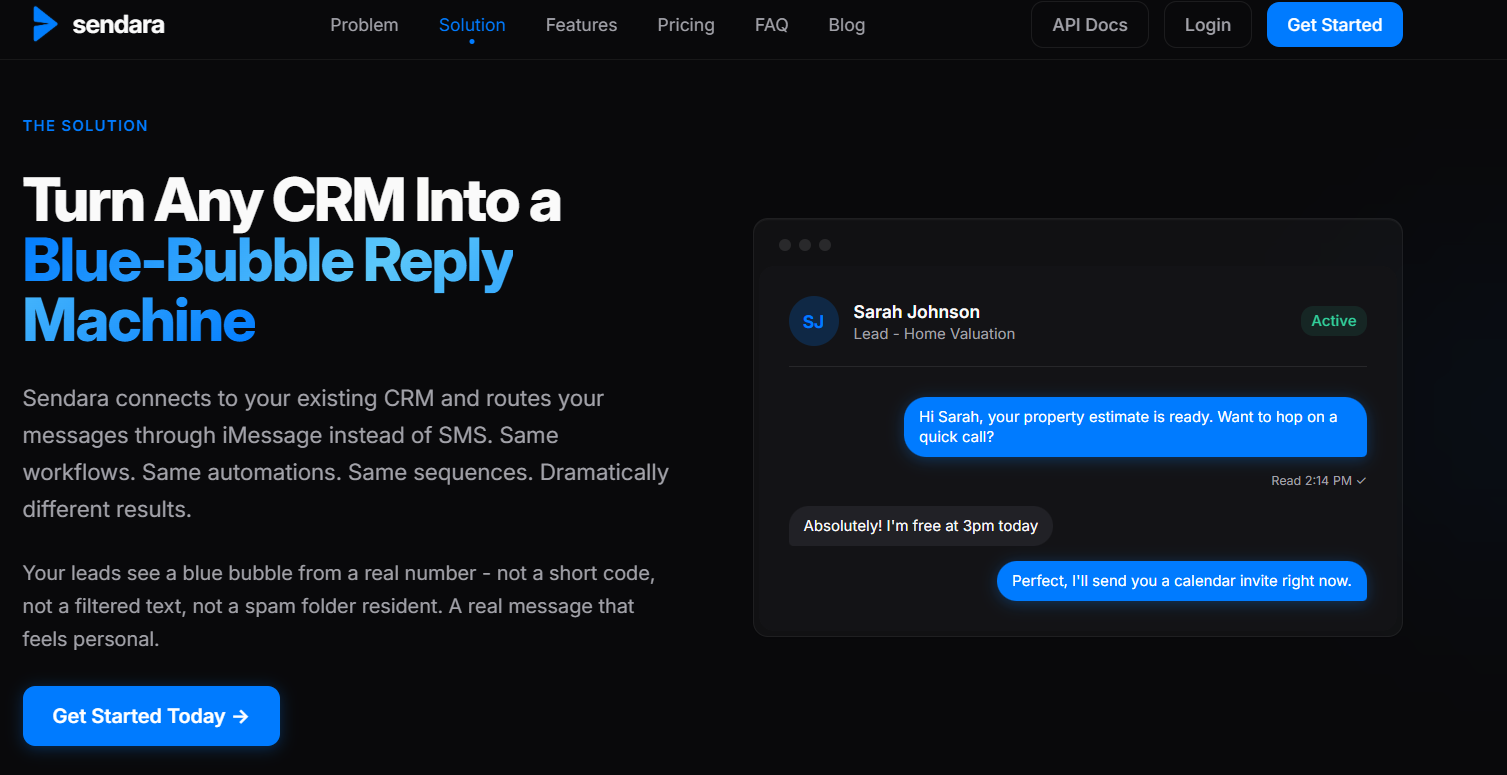
For sales teams, a secure iMessage API needs to do more than protect customer data. It should also keep every conversation inside the CRM and lower the risk of interruptions with prospects.
Sendara connects to your CRM in one click, so your current workflows keep running whether you set up iMessage for GoHighLevel or HubSpot.
Reps send and receive text messages from the CRM or the mobile app, and read receipts show when a prospect has seen the text. Agency mode also lets one login manage many client accounts.
Each business gets a dedicated number, and opt-in rules lower the risk of spam reports.
When a contact cannot receive an iMessage, RCS or SMS fallback gives smooth message delivery, so prospects on Android still get your texts.
FAQs About the Most Secure iMessage API Provider
Which messaging app is best for private, encrypted chats?
Signal and iMessage are among the most trusted secure messaging apps, since both use end-to-end encryption by default.
Facebook Messenger now encrypts personal chats by default as well, but in-app messaging inside other tools may not, and push notifications can still show parts of a message on a locked screen.
Which is safer, SMS or WhatsApp?
WhatsApp is safer because it encrypts every chat end to end, video calls included. SMS and MMS travel over carrier networks without that protection, and their notifications can show message content to anyone who sees the phone.
Does iMessage have an API?
Apple has no public iMessage API, and its official tools for iOS apps only let an app open a prefilled text for the user to send.
Third-party providers fill that gap with their own Apple hardware, allowing businesses to handle sending and receiving messages through API functions inside their CRM.
Which SMS API provider is the best?
Twilio is one of the most widely used SMS APIs, since it is highly scalable and handles high message volume for businesses of any size. For blue-bubble texts, an iMessage API provider such as Sendara reaches iPhone users and falls back to SMS for everyone else.